Skip to content
By Health Reflected Team Published: December 12, 2025 | Updated: February 12, 2026 Categories: [Mental Health], [Wellness], [Holistic Therapy], [Stress Management]
Is your body shouting while your mouth stays silent?
Imagine this scenario: You are sitting at your desk. You are safe. There is no tiger chasing you. Yet, your heart is racing, your jaw is clenched tight enough to crack a walnut, and your shoulders are practically touching your ears. You feel an inexplicable sense of urgency, a low-level hum of anxiety that never quite turns off. Or perhaps you feel the opposite—a heavy, numb fog where motivation goes to die.
If this sounds familiar, you aren’t "broken," and you aren’t just "stressed." You are likely experiencing a dysregulated nervous system.
In the evolving landscape of 2026 health trends, we have finally stopped treating the mind and body as separate entities. We now know that "talk therapy" alone isn't always enough because trauma and chronic stress are not just stored in the brain; they are stored in the body.
This comprehensive guide will explore somatic exercises for nervous system regulation—the missing link in your wellness routine. We will dive deep into the science of the Vagus nerve, the Polyvagal Theory, and provide you with a robust toolkit of movements to help you transition from "surviving" to "thriving."
Table of Contents
Part 1: The Silent Epidemic of Nervous System Dysregulation
To understand why somatic exercises are the specific antidote to modern burnout, we must first understand the biology of stress.
The "Tired but Wired" Phenomenon
In our modern world, we are bombarded with micro-stressors: the ping of an email, the blue light of a screen, traffic, financial worry. Unlike our ancestors, who faced acute threats (a predator) followed by long periods of rest, our threats are chronic and low-grade.
This keeps the Autonomic Nervous System (ANS) stuck in an "ON" position.
According to a 2024 report by the American Psychological Association, over 76% of adults report physical symptoms of stress, including fatigue, headache, and muscle tension. This isn't just "feeling stressed"; it is a physiological state where the body’s chemistry is altered by cortisol and adrenaline.
The Three States of Your Nervous System
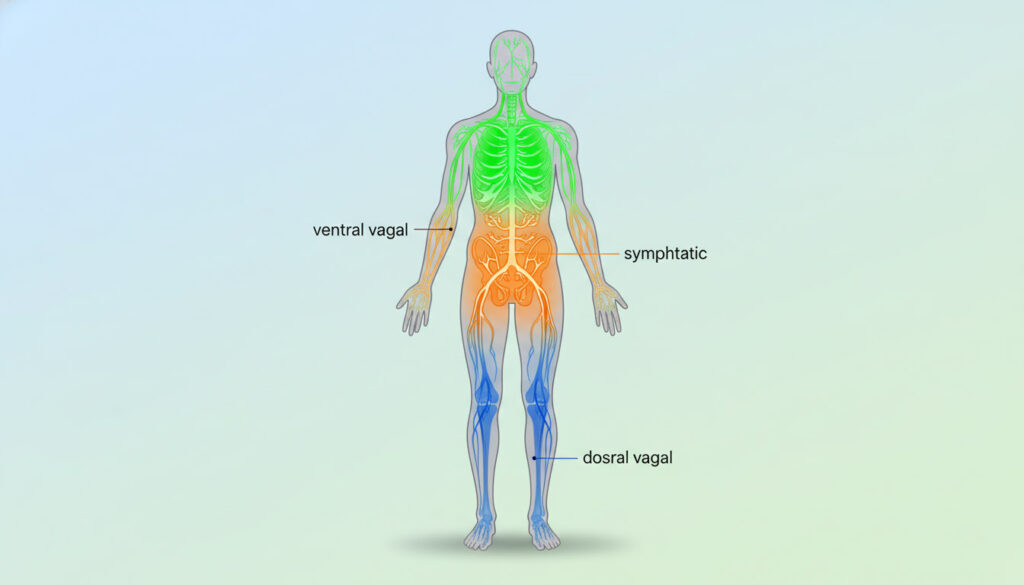
Drawing from the renowned Polyvagal Theory developed by Dr. Stephen Porges, your nervous system isn't just a binary switch (stress vs. calm). It is a hierarchy of three states:
- Ventral Vagal (Safety & Connection):
- The "Rest and Digest" state.
- How it feels: Calm, curious, social, grounded. Digestion works, heart rate is variable and resilient.
- Goal: We want to spend most of our time here.
- Sympathetic (Mobilization/Fight or Flight):
- The "Danger" state.
- How it feels: Anxious, angry, racing thoughts, restless energy.
- Physical signs: Dilated pupils, rapid shallow breathing, tension in the jaw and hips.
- Dorsal Vagal (Immobilization/Freeze):
- The "Life Threat" state.
- How it feels: Numb, depressed, dissociated, "checking out," chronic fatigue.
- Physical signs: Heaviness in limbs, digestive shutdown, blank stare.
Somatic exercises are designed to help you navigate this ladder. If you are stuck in Sympathetic (anxiety), they help discharge that energy. If you are stuck in Dorsal (depression), they help gently wake the body up.
Part 2: What Are Somatic Exercises? (More Than Just Stretching)
The term "somatic" comes from the Greek word soma, meaning "the body as perceived from within."
Unlike Yoga, Pilates, or traditional stretching—which often focus on how the movement looks or performing a shape correctly—somatic exercises focus entirely on interoception: how the movement feels internally.
The Concept of "Sensory-Motor Amnesia"
Thomas Hanna, a pioneer in the field of somatics, coined the term Sensory-Motor Amnesia (SMA). This occurs when muscles become so habitually tight due to stress or injury that the brain actually "forgets" how to relax them.
- Example: If you sit at a computer for 10 years, your brain learns that "slumped shoulders" is your neutral state. You can't just "stand up straight" because your brain has mapped the slump as normal.
Somatic exercises use a technique called Pandiculation to fix this.
- Stretching: Pulling a muscle to length (passive).
- Pandiculation: Consciously contracting a muscle more than it is already tight, then VERY slowly releasing it to full relaxation (active re-learning).
Expert Insight: "Trauma is not what happens to you, but what happens inside you in the absence of an empathetic witness." — Dr. Peter Levine, founder of Somatic Experiencing.
Somatics vs. Other Modalities
| Feature | Somatic Exercises | Yoga | Traditional PT |
| Primary Goal | Nervous System Regulation | Flexibility, Strength, Spiritual | Rehab specific injury |
| Focus | Internal Sensation (Interoception) | Alignment, Breath, Flow | Range of Motion, Strength |
| Speed | Extremely Slow | Variable | Variable |
| Effort | Low (Lazy/Gentle) | Low to High | Moderate to High |
| Brain State | Alpha/Theta (Meditative) | Varies | Beta (Active focus) |
Part 3: Signs You Need Somatic Regulation
You might be wondering, "Do I really need this? I exercise regularly." Even athletes can have dysregulated nervous systems. In fact, High-Intensity Interval Training (HIIT) can sometimes exacerbate high cortisol levels if not balanced with rest.
Check the signs below. Do you experience…?
Physical Indicators:
- [ ] Chronic tension headaches or migraines.
- [ ] TMJ or teeth grinding (bruxism) at night.
- [ ] Digestive issues (IBS, bloating) with no clear dietary cause.
- [ ] Shallow breathing (chest breathing) rather than belly breathing.
- [ ] Sensitivity to light and sound.
- [ ] "Tech Neck" or a hump at the base of the neck.
Emotional/Mental Indicators:
- [ ] Irritability or "snapping" at loved ones easily.
- [ ] Brain fog or difficulty concentrating.
- [ ] Feeling "stuck" or unable to move forward in life.
- [ ] Difficulty falling asleep (racing mind) or staying asleep (waking at 3 AM).
- [ ] A sense of detachment from your own body.
If you checked more than three boxes, your nervous system is likely asking for support.
Part 4: The 7 Best Somatic Exercises for Nervous System Regulation
Below are seven powerful, science-backed movements. These range from exercises that stimulate the Vagus Nerve to those that release deep muscular armor.
Preparation:
- Find a quiet space where you won't be disturbed.
- Wear loose, comfortable clothing.
- Remove distractions (silence your phone).
1. The Basic Neuro-Reset (The Salamander)
Target: The Vagus Nerve & Neck Tension
This exercise, popularized by Stanley Rosenberg in his book Accessing the Healing Power of the Vagus Nerve, physically shifts the atlas and axis vertebrae to improve blood flow to the brainstem.
- Position: Sit comfortably or lie on your back. Interlace your fingers and place them behind your head, cradling the base of your skull.
- The Look: Keeping your head perfectly still (facing forward), move only your eyes to look as far to the right as you comfortably can.
- The Hold: Hold this gaze for 30–60 seconds.
- The Sign: Wait for a physiological sign of release: a yawn, a swallow, or a deep sigh. This signals the switch from Sympathetic to Parasympathetic.
- Switch: Return eyes to center, then look to the left and repeat until you yawn or sigh again.
2. The "Voo" Sound (Vocal Toning)
Target: Vagus Nerve Stimulation via Vocal Cords
The Vagus nerve passes through the vocal cords. Vibration is one of the fastest ways to stimulate it.
- Inhale: Take a deep breath into your belly.
- Exhale: Make a deep, foghorn-like sound: "Voooooo."
- Focus: Visualise the sound vibrating down your throat, into your chest, and all the way to your pelvic floor.
- Repeat: Do this for 2–3 minutes. Why it works: This mimics the physiological effects of chanting, known for centuries to calm the mind.
3. Somatic Shaking (The Trauma Release)
Target: Discharging Adrenaline & Cortisol
Have you ever seen a gazelle shake after escaping a lion? Animals literally "shake off" the trauma to reset their baseline. Humans have been socially conditioned to suppress this urge.
- Stand: Feet hip-width apart, knees soft/bent.
- Start: Begin bouncing from your knees. Let your heels thump the ground lightly.
- Loose Arms: Let your arms flop like cooked spaghetti. Let your jaw hang loose.
- Build It: Shake your hands, your hips, your shoulders. Imagine flicking water off your fingertips.
- Duration: Shake vigorously for 1–2 minutes.
- The Pause: Stop suddenly. Close your eyes. Feel the tingling sensation (Qi/Energy/Blood flow) running through you. This is the feeling of aliveness.
4. The Psoas Release (Constructive Rest)
Target: The "Muscle of the Soul" (Hips/Lower Back)
The Psoas muscle connects the torso to the legs and is the primary muscle involved in the "flight" response (running away). It stores massive amounts of emotional tension.
- Lie Down: On your back, knees bent, feet flat on the floor wider than hip-width.
- Collapse: Let your knees fall inward to touch each other (tenting). This allows the psoas to go completely slack.
- Arms: Place hands on your belly.
- Wait: Lie here for 10–15 minutes. You may feel your legs start to tremble or twitch. Let them. This is neurogenic tremors releasing deep tension.
5. Ear Massage (Auricular Vagus Stimulation)
Target: Instant Anxiety Relief
A branch of the Vagus nerve (the auricular branch) surfaces in the ear.
- Pinch: Gently pinch the skin of your earlobes and pull down gently.
- Cycle: Use your finger to trace the ridge of your inner ear (the Cymba Concha).
- Pull: Gently pull the ears out to the side, opening the ear canal.
- Breath: Pair this with slow, deep breathing.
6. The "Self-Hug" Container
Target: Boundaries & Safety
This creates a physical sensation of containment, vital for those who feel "scattered" or dissociated.
- Cross: Place your right hand under your left armpit, hugging your ribcage.
- Hold: Place your left hand on your right upper arm/shoulder.
- Squeeze: Give yourself a firm, containing squeeze.
- Rock: Gently rock side to side. Why it works: This replicates the sensation of being held, releasing oxytocin (the bonding hormone) which counters cortisol.
7. Slow Hip Circles (Pelvic Clock)
Target: Lower Back & Sacral Tension
- Lie: On back, knees bent.
- Imagine: There is a clock face under your pelvis. 12 is your navel, 6 is your tailbone.
- Tilt: Gently tilt pelvis to 12 (flatten back), then to 6 (arch back).
- Rotate: Now try to roll your pelvis around the numbers: 12, 1, 2, 3... all the way around.
- Precision: Make the movement as smooth as possible. If it feels "jerky" at certain numbers, that is Sensory-Motor Amnesia. Slow down and go back and forth over the jerky spot until it smoothes out.
Part 5: Building a Somatic Routine for Real Life
You do not need to carve out an hour a day. The beauty of nervous system regulation is that frequency matters more than duration. Micro-dosing safety signals throughout the day is more effective than one mega-session.

The "Busy Professional" Protocol
Morning (2 Minutes):
- Bed: Do a full body Pandiculation (stretching and yawning) like a cat before getting up.
- Bathroom: While brushing teeth, stand on one leg or do a quick Ear Massage.
Mid-Day (Work Reset):
- The Toilet Break: If you are in an office, use a bathroom stall to do 60 seconds of Somatic Shaking or the Silent Scream (scrunching face tight, then releasing).
- Desk: Perform the Salamander eye movements to reset after screen time.
Evening (Wind Down):
- Floor Time: Spend 5 minutes in Constructive Rest (knees knocked together) while scrolling your phone or listening to a podcast.
- Voo Breath: 3 rounds of Voo breathing to signal the body it is time to sleep.
Part 6: Scientific Limitations and Critical Considerations
At Health Reflected, we prioritize accuracy. While somatic exercises are powerful, they are not a cure-all.
- It’s Not a Quick Fix: Neural pathways take time to change. Neuroplasticity requires repetition. Expect to practice for 3–4 weeks before noticing a permanent shift in your baseline anxiety.
- The "Backlash" Effect: Sometimes, when we finally relax, we feel worse initially. We might feel exhausted or suddenly tearful. This is normal—it’s the "thaw" after the freeze.
- When to Seek Help: If somatic exercises trigger intense flashbacks or panic attacks, pause. You may need the guidance of a certified Somatic Experiencing Practitioner (SEP) to help you titrate the release safely.
Related Reading: If you are interested in the biochemistry of stress, read our deep dive on [Understanding Cortisol: Friend or Foe?] and [The Gut-Brain Axis Explained].
Conclusion: Reclaiming Your Body
We live in a culture that treats the body like a machine to be driven—caffeinated to wake up, sedated to sleep, and pushed to the limit in between. Somatic exercises for nervous system regulation are an invitation to stop driving the machine and start inhabiting the animal.
By learning the language of your nervous system, you gain agency over your own well-being. You learn that you don't have to be a victim of your stress response. You have the tools, literally at your fingertips, to return to safety.
Start small. Pick one exercise from this list today. Your nervous system has been waiting for you to listen.
Frequently Asked Questions (FAQ)
What is the difference between somatic exercises and meditation?
Meditation is a "top-down" approach (using the mind to calm the body). Somatic exercise is a "bottom-up" approach (using the body to calm the mind). For people with high trauma or anxiety, sitting still in meditation can sometimes be triggering; somatics offers a movement-based alternative that can be more accessible.
Can somatic exercises heal trauma?
Somatic exercises are a tool for processing trauma stored in the body, but they are most effective when used as part of a broader therapeutic approach. They help release the "fight or flight" energy that gets trapped after a traumatic event, which is a crucial part of healing according to experts like Dr. Peter Levine.
How often should I do somatic exercises?
Daily is best. Your nervous system is constantly scanning for danger, so giving it daily signals of safety is crucial. Even 5 minutes a day is effective.
Are there any side effects?
You may experience emotional release (crying, anger), physical twitching, or extreme fatigue immediately after. These are signs of release, not injury. Hydrate well and rest if this occurs.
Can I do these if I have chronic pain or fibromyalgia?
Yes, somatics are often recommended for chronic pain because they are gentle and non-impact. They address the sensory-motor amnesia that often contributes to chronic muscle guarding and pain loops.
For further reading on holistic health, explore our categories on [Sleep Hygiene] and [Nutritional Psychiatry].
References & Further Reading:
- Porges, S. W. (2011). The Polyvagal Theory: Neurophysiological Foundations of Emotions, Attachment, Communication, and Self-Regulation.
- Levine, P. A. (2010). In an Unspoken Voice: How the Body Releases Trauma and Restores Goodness.
- Hanna, T. (1988). Somatics: Reawakening the Mind's Control of Movement, Flexibility, and Health.
- Kimura, K., et al. (2023). "The effects of slow breathing on the autonomic nervous system." Journal of Physiological Sciences.